
![[090]20200729_Amberfaet_037(FULL)](https://adammostel.com/wp-content/uploads/2022/01/09020200729_Amberfaet_037FULL.png "[090]20200729_Amberfaet_037(FULL)")
![[070]20200729_HalnirPassCave_001(FULL)](https://adammostel.com/wp-content/uploads/2022/01/07020200729_HalnirPassCave_001FULL.png "[070]20200729_HalnirPassCave_001(FULL)")
![[060]20200729_Faerthale_028(FULL)](https://adammostel.com/wp-content/uploads/2022/01/06020200729_Faerthale_028FULL.png "[060]20200729_Faerthale_028(FULL)")
![[020]20200729_Sleepless_039(FULL)](https://adammostel.com/wp-content/uploads/2022/01/02020200729_Sleepless_039FULL.png "[020]20200729_Sleepless_039(FULL)")
![[040]20200803.FTpond(FULL)](https://adammostel.com/wp-content/uploads/2022/01/04020200803.FTpondFULL.png "[040]20200803.FTpond(FULL)")
![[030]20200729_Amberfaet_033(FULL)](https://adammostel.com/wp-content/uploads/2022/01/03020200729_Amberfaet_033FULL.png "[030]20200729_Amberfaet_033(FULL)")
As part of an initiative to improve the combat experience* in Pantheon, I was responsible for the redesign of 12 player classes and their unique resources and abilities.
Examples of these redesigns can be found in the below articles:
Other contributions include:
*The most recent public stream of Pantheon gameplay shown here represents a previous iteration of combat. While the clips shared highlight some of my work, most of the current gameplay and abilities shown were created previously by other team members.
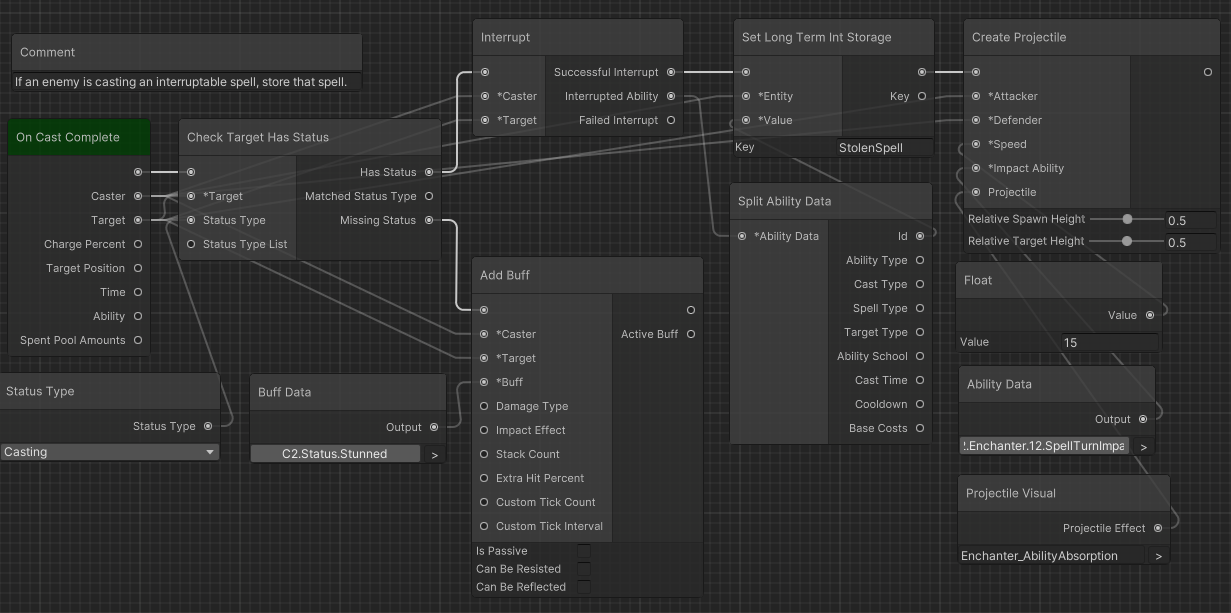
An example of one of the Enchanter's signature abilities: Spell Turn.
When Spell Turn is used against an enemy casting an interruptable ability, we interrupt that ability and store its ID. We then create a projectile visual effect that flies from the enemy to the caster, representing the stolen magic.
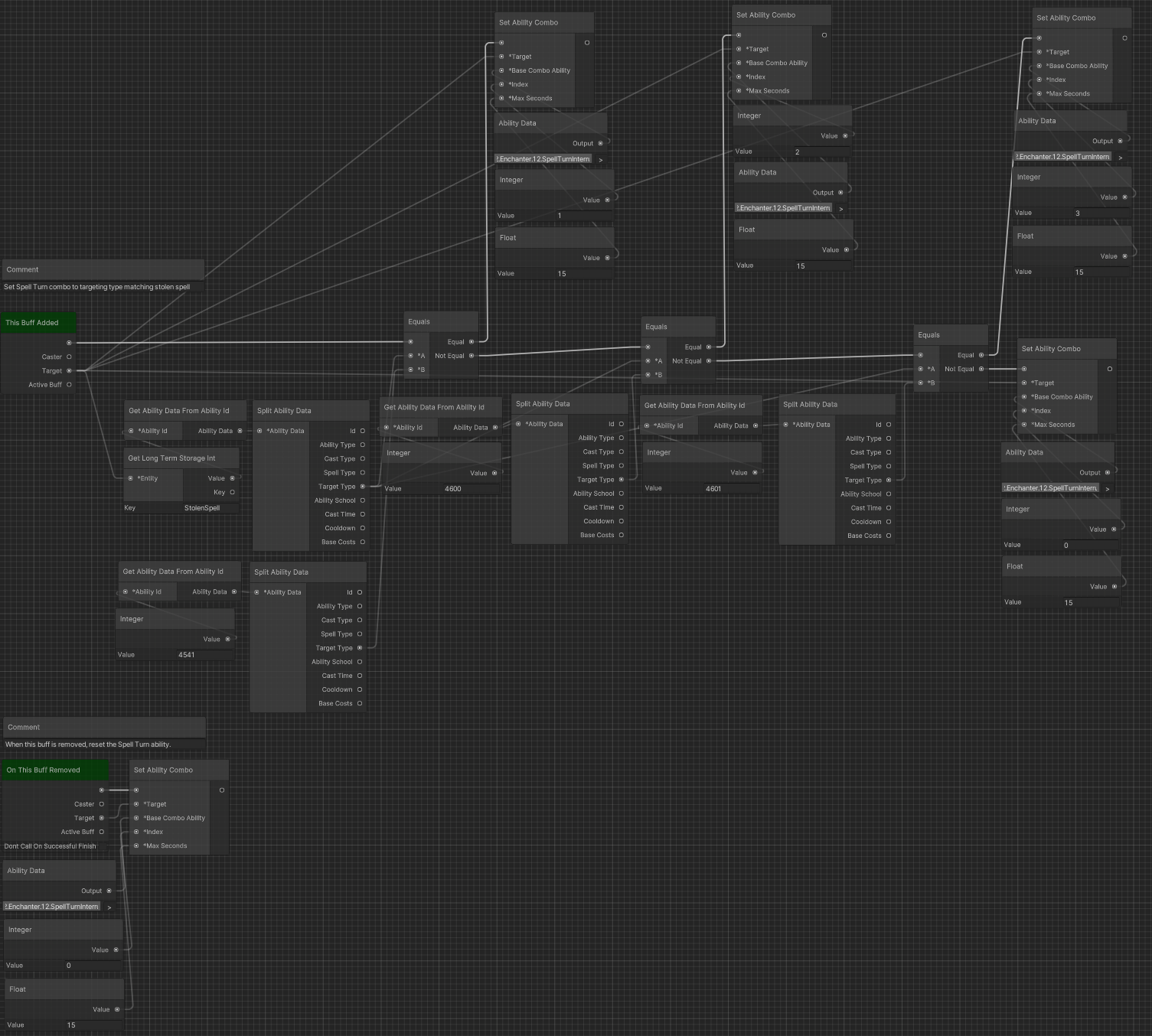
When the projectile reaches the caster, it grants them a buff which changes their Spell Turn ability into a Release ability. We detect the targeting type of the stolen ability, and assign a version of Release that matches the targeting type.
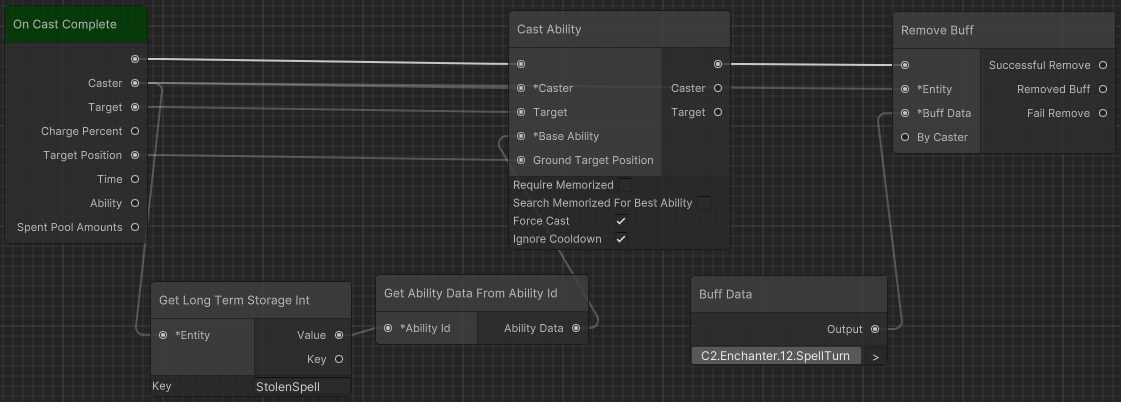
Once released, we remove the stored ability from the caster.
One of Pantheon's design goals is to break through the typical MMORPG monotony of battling the same NPCs over and over via its Dispositions & Traits system.
Dispositions represent changes to an enemy's default behaviors - for example, defining reactions to certain player-initiated events such as calling for assistance when attacked. Traits, meanwhile, are modifiers to core enemy attributes or abilities - for example, an immunity to a certain type of damage.
I was responsible for designing and implementing the various Dispositions and Traits that players will encounter, as well as the designing the systems to propagate these elements across the vast population of NPCs in Pantheon.
CohhCarnage discovers the 'Superheated' trait...the hard way.
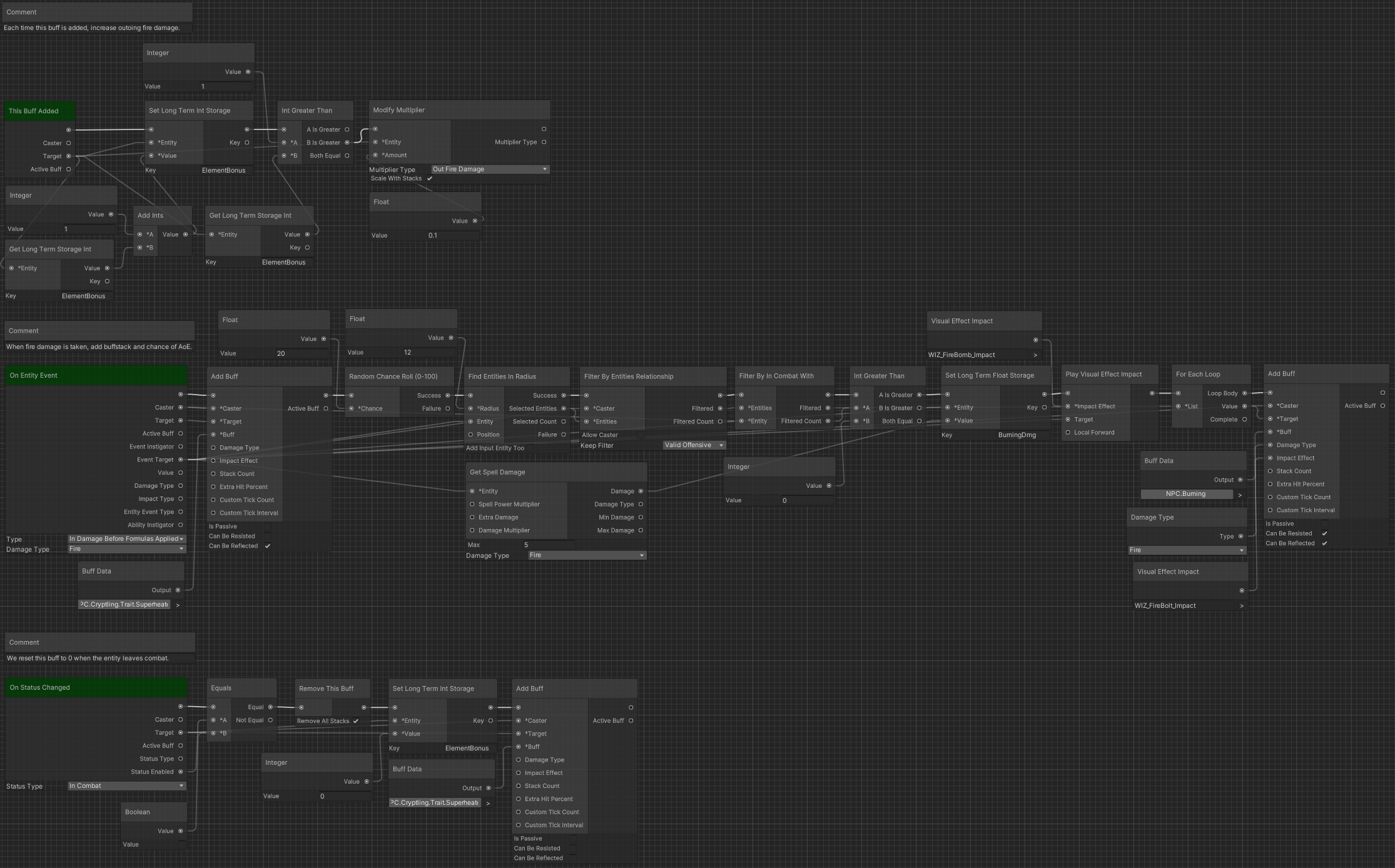
When receiving fire damage, enemies with the 'Superheated' trait gain a stacking buff to their outgoing fire damage, as well as have a chance to deal AoE damage.
Like any good MMORPG, Pantheon features no small amount of signature bosses and encounters throughout its overworld and dungeons.
I was responsible for designing the moment-to-moment gameplay of these encounters, including C# scripting where necessary to overcome the limits of our visual scripting tools.
Contributions include:
CohhCarnage and the Pantheon team face off against the Thief of Eternity.
In order to grant the most Designer flexibility, encounters can be created using Pantheon's visual scripting tools rather than requiring hard-coding.
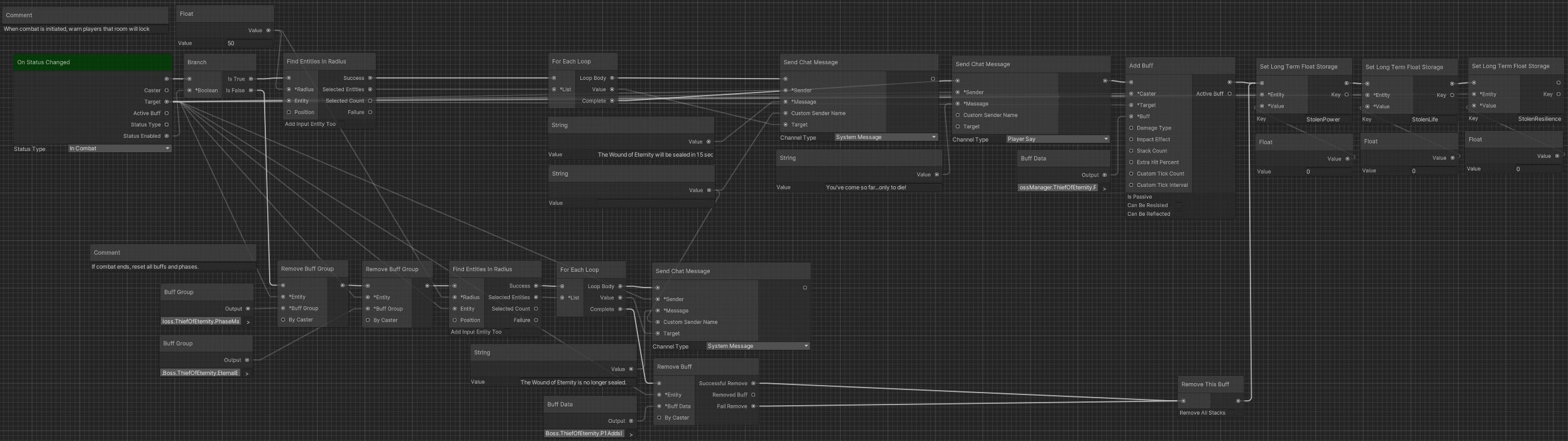
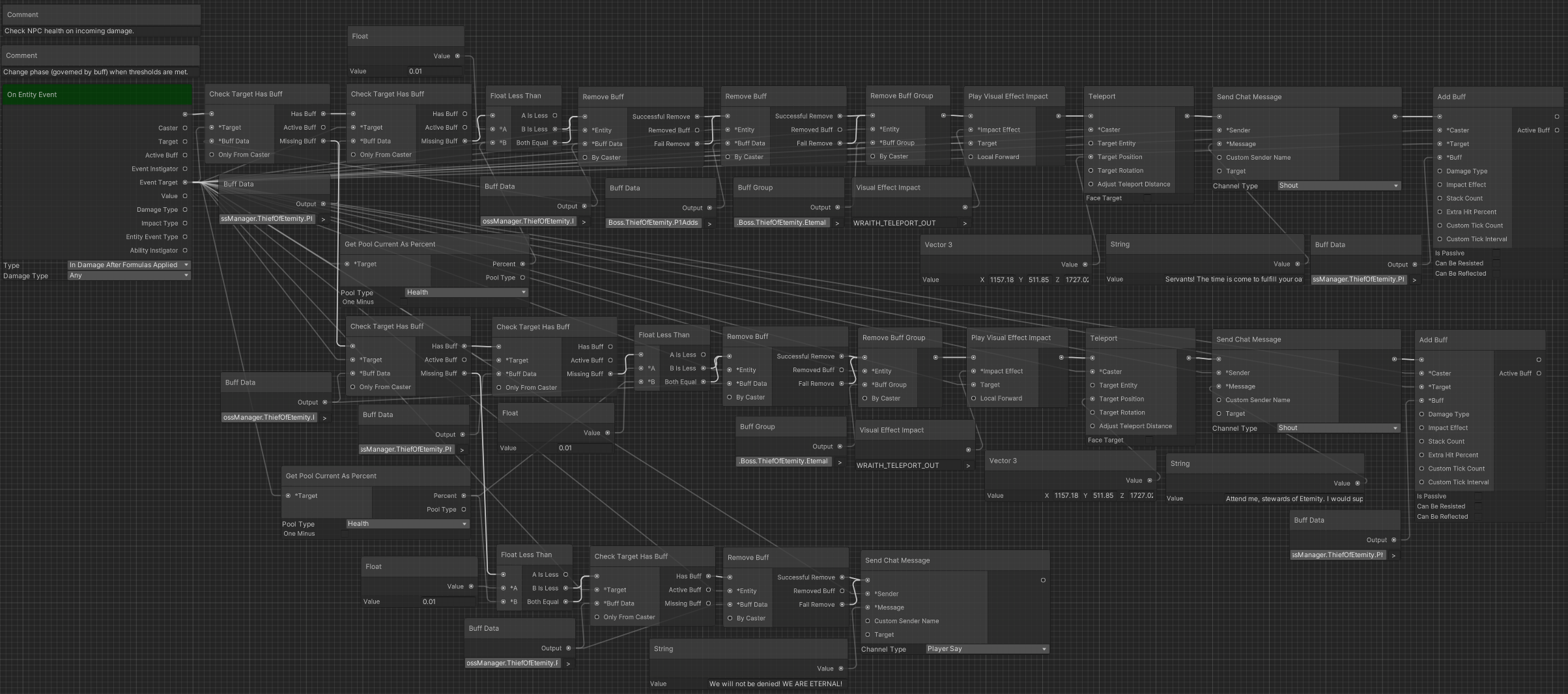
The Thief of Eternity's behaviors are managed via a series of buffs which are tracked, added, and removed as necessary via a central encounter manager buff.
The core rules of the buff dictate both resetting the manager buff if the encounter itself resets, and whether or not to reset the encounter based on attempts to pull the boss from his room.
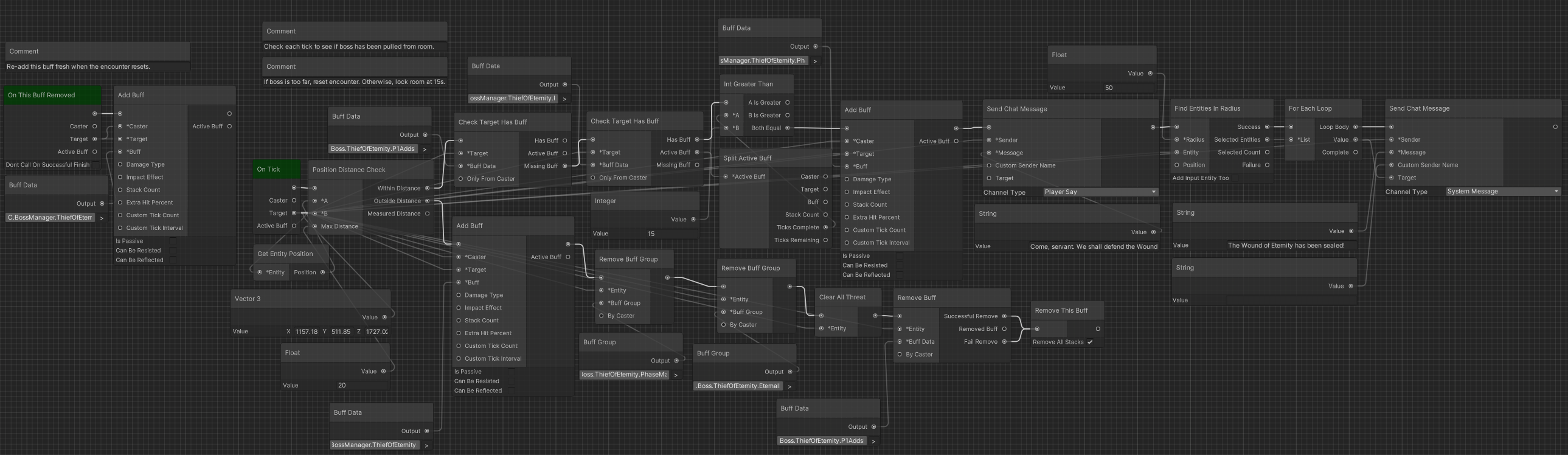
We also do checks on the combat state of the boss. If the boss is out of combat and enters combat (due to being aggro'd), we initiate the encounter. If the boss ends combat (due to defeating players), we reset.
The rest of the encounter is managed via the buffs that dictate what actions the boss will take, when, and during which phases. An overall check on the boss's current health, performed whenever incoming damage is received, determines whether or not a phase transition should occur.
Pantheon is being developed by a small, agile team. As such, the need for powerful tools to enable designers to create content quickly and efficiently is paramount. I helped to bridge the gap between our engineering and design teams by translating designer needs into specifications for programmers, identifying gaps in functionality, and pinpointing opportunities for usability improvements.
I also provided supplemental support to the engineering team by owning the creation and maintenance of new functions and blueprint nodes, formulas, and minor UI elements.
Contributions include: